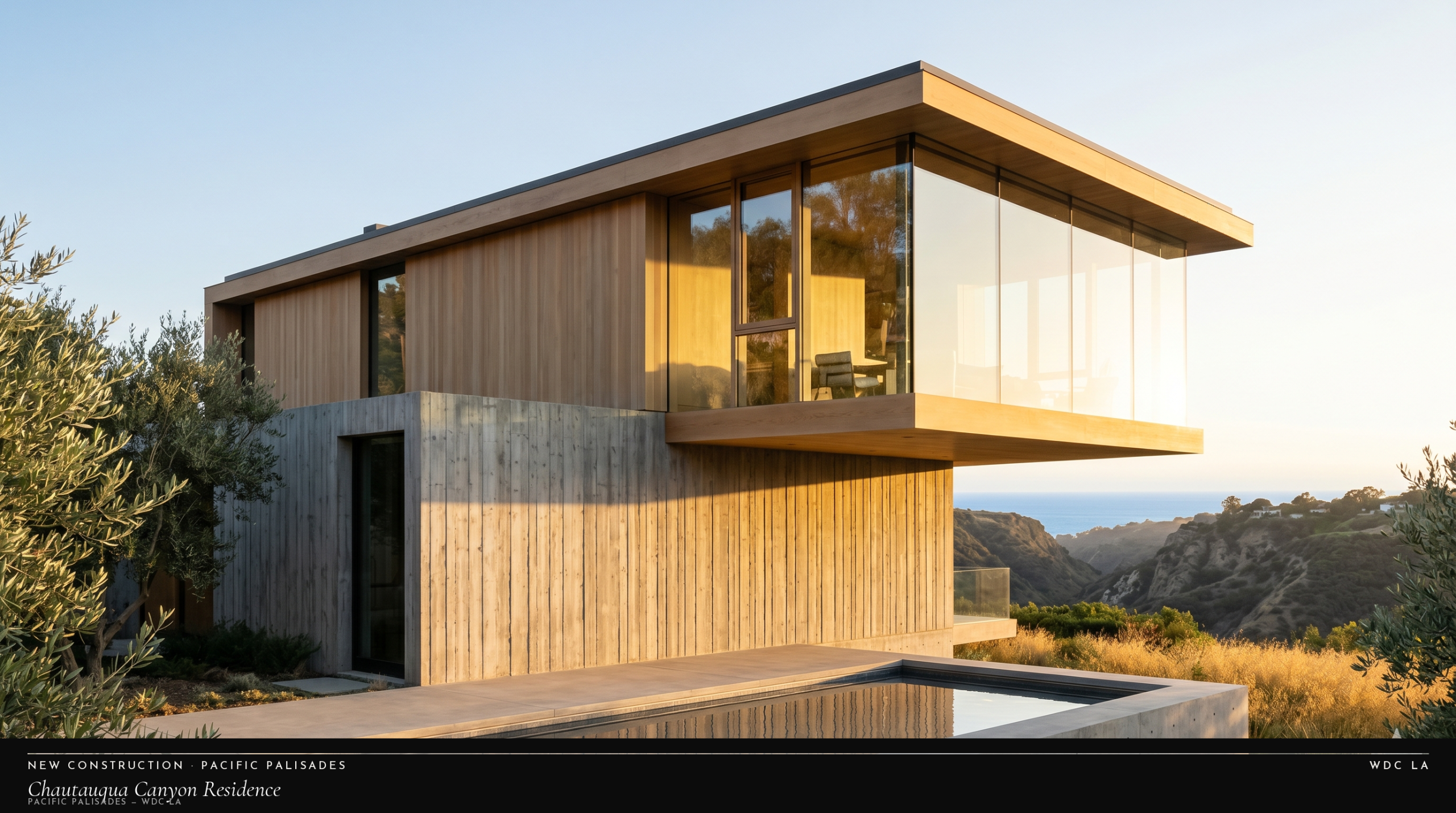
Coastal modernist new construction in Pacific Palisades typically runs 32 to 44 months from lot acquisition to Certificate of Occupancy, with hard costs between $1,000 and $1,800 per square foot at the design-led tier. The additional time and cost — measured against a comparable inland Los Angeles build — comes from the Coastal Zone permitting layer: a Coastal Development Permit issued by the City of Los Angeles, potentially appealable to the California Coastal Commission, with stand-alone reviews for visual impact, public access, sensitive habitat, and view-corridor preservation. We Do Construction — a Los Angeles design-build firm licensed in California (CSLB #1096552) and listed in the Architectural Digest PRO Directory — builds inside the Coastal Zone. The Chautauqua Canyon Residence, a current WDC project on the canyon-side slope between Chautauqua Boulevard and Pacific Coast Highway, is a working illustration of the permit sequencing, structural decisions, and material specifications that a Palisades coastal build actually requires.
Project
Chautauqua Canyon Residence
Neighborhood
Pacific Palisades · canyon-side · between Chautauqua and PCH
Status
In design · 2026
Permit
Coastal Development Permit · CDP track
Envelope
Stainless 316 · PG-50 glazing · marine-grade
Delivery
Design-build · WDC
Lot to C of O
per Sq Ft
CDP Timeline
Material Premium
The Coastal Zone is the first question on every Palisades project

Two questions answered in the first week, in this order:
- Is the parcel inside the Coastal Zone? Pacific Palisades is bisected by the Coastal Zone boundary. Lots west of Pacific Coast Highway, the entire bluff edge, and most parcels south of Sunset Boulevard within roughly 1,000 yards of the ocean fall inside it. The boundary is parcel-specific and verified through the LA City Planning Coastal Zone map.
- Is the parcel inside the appealable zone? The appealable zone — generally the first row of bluff-top parcels and lots west of PCH — gives the California Coastal Commission appellate jurisdiction over the local CDP. Any aggrieved person has 10 working days from the City of LA’s action to appeal. Outside the appealable zone but inside the Coastal Zone, the local CDP is final.
If the answer to question one is yes, every downstream decision — siting, height, footprint, glazing — runs through the Coastal lens.
Inside the Coastal Zone, every downstream decision — siting, height, footprint, glazing — runs through one lens. Outside it, you are designing in Los Angeles. Inside it, you are designing in California.— Jacob Bachar, WDC
What a Coastal Development Permit actually contains
A CDP application is the plan-check package plus four stand-alone reviews. Each is its own consultant scope:
Typical CDP timeline from filing to issued permit: 6 to 10 months if there is no appeal. Add 4 to 8 months if the project is appealed to the California Coastal Commission.
Structural decisions specific to coastal exposure
The structural and mechanical specifications change inside the Coastal Zone:
- Marine-grade fasteners and finishes — stainless 316 on exterior fasteners, zinc or aluminum cladding rather than mild steel, factory-finished aluminum window systems instead of bare steel.
- Corrosion protection on structural steel — hot-dip galvanized at minimum, sometimes powder-coated over galvanized for cantilevers and exposed members.
- Elevated and protected mechanicals — HVAC condensers and pool equipment specified for coastal-zone corrosion class C5-M; locations chosen to avoid direct salt-spray exposure.
- Glazing for wind-driven rain — Performance-Grade (PG) ratings stepped up one or two grades versus inland standard.
The Chautauqua Canyon Residence specifies stainless 316 fasteners throughout the exterior envelope, factory-finished aluminum window systems, and PG-50 glazing — a calibrated step above standard PG-35 inland.
Architectural vernacular for the Palisades

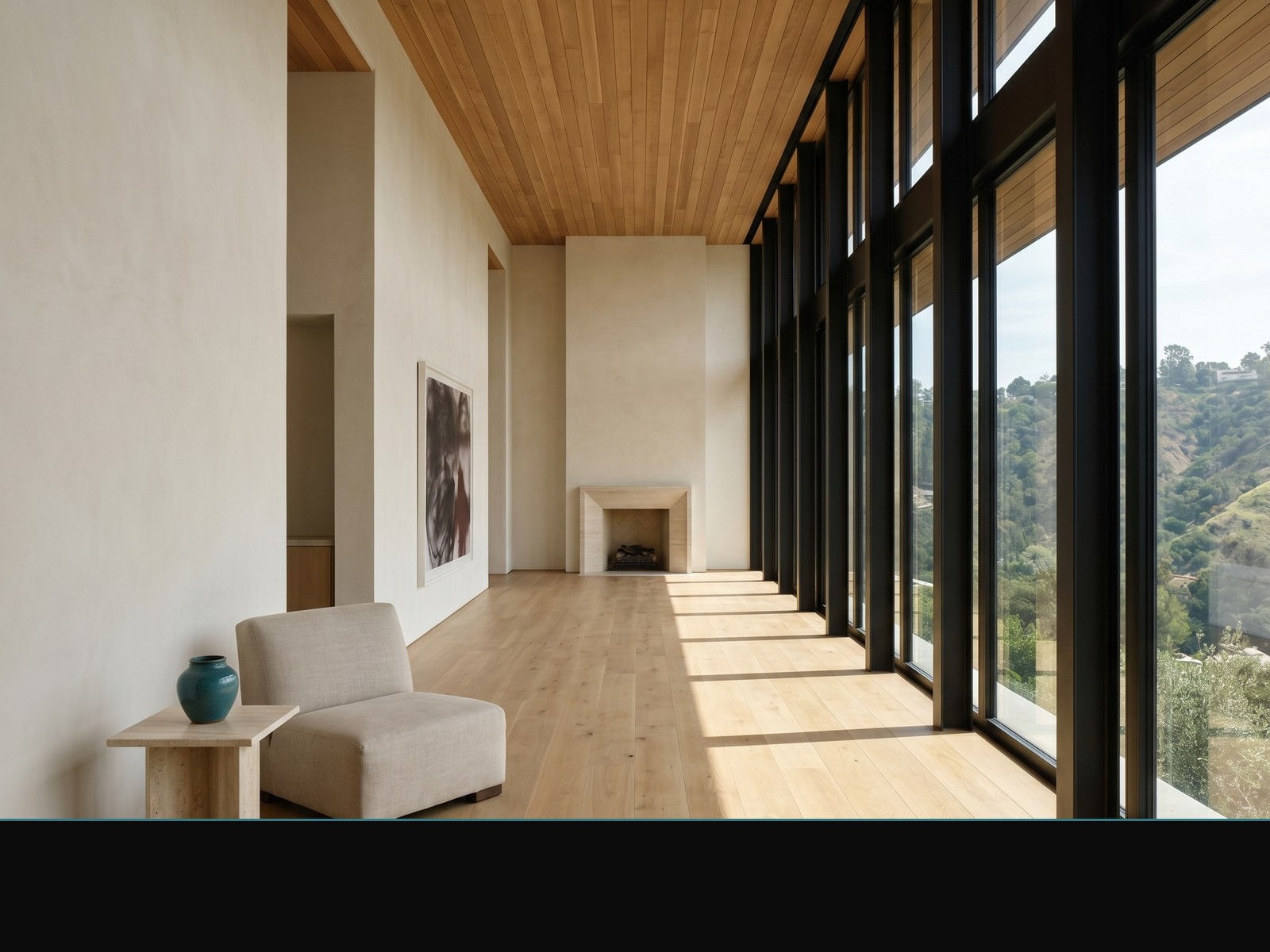
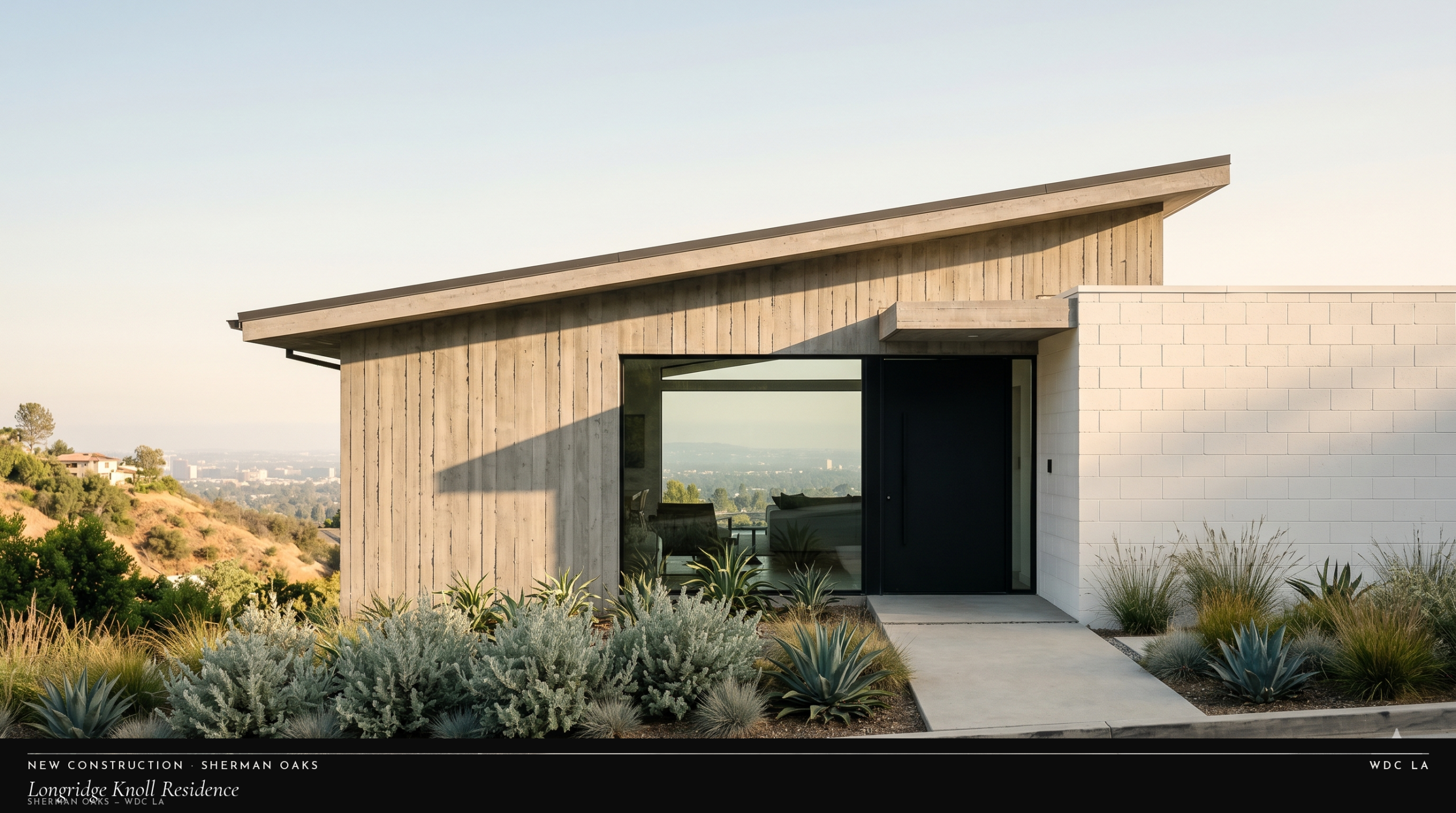
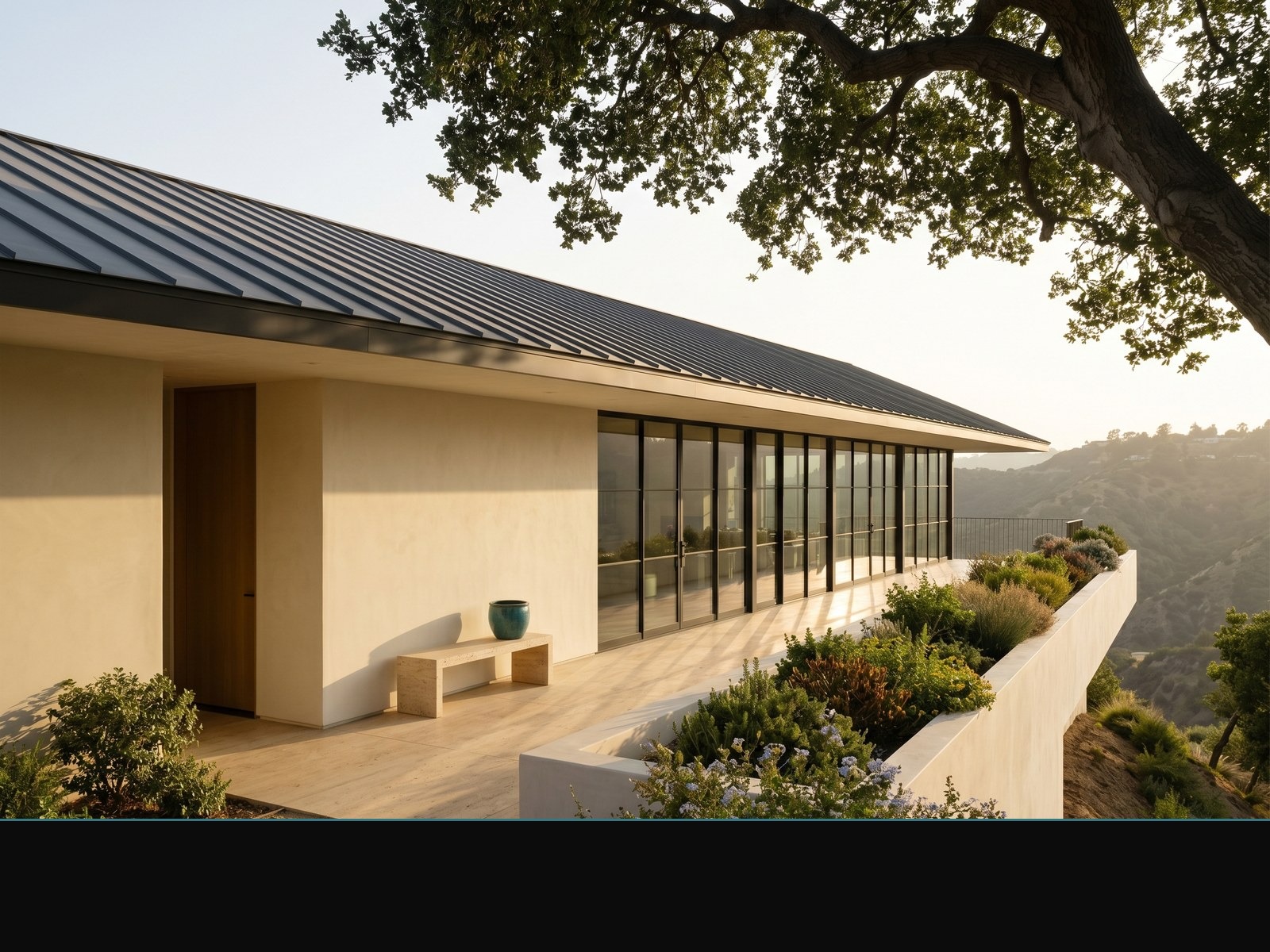
Coastal modernist architecture in Pacific Palisades draws from a clear lineage — the Case Study Houses, the Cliff May ranches of the post-war Palisades, and the canyon modernism developed by Ray Kappe and Frank Israel through the 1970s and 1980s. The pattern that holds up on current WDC Palisades ground-up builds: low horizontal massing oriented to the canyon or ocean view, single-loaded corridor plans that put every primary room on the view side, board-formed concrete or smooth-troweled plaster paired with stained cedar or vertical-grain Douglas fir, and roof planes that float on a clerestory rather than meeting the wall directly. Glazing is generally west or southwest, with deep overhangs sized for summer shading. Pools are oriented to the view, not parallel to the property line. Material palettes stay at two primary materials plus one accent — restraint, not minimalism. Color saturation belongs to the landscape, not the building.
Case Study Houses, Cliff May ranches, and the canyon modernism of Ray Kappe and Frank Israel. The Palisades vernacular is already written. The work is to extend it, not reinvent it.— On Pacific Palisades lineage
Palisades Fire rebuild context (post-January 2025)
For lots inside the Palisades Fire burn perimeter, footprint preservation is the decision that drives everything else. Like-for-like rebuilds — same footprint, height, and floor area — generally qualify for expedited Coastal review under post-disaster recovery provisions adopted after the January 2025 fire. Expansions beyond the prior footprint trigger full CDP review.
The trade-off is concrete: 6 to 10 months of permitting time, weighed against the program changes a 20-year-old footprint may need. The decision should be made at the architecture-programming stage, not after schematic design has set expectations.
Timeline, end to end
- Lot acquisition + Coastal Zone verification: 1–2 months
- Pre-design (geotech, survey, programming, CDP scoping): 4–6 months
- Schematic Design and Design Development: 5–7 months
- Construction Documents: 5–6 months
- CDP submittal, plan check, permit: 6–10 months (longer if appealed)
- Construction: 18–24 months
- Total: 32 to 44 months
What the numbers actually look like
Why design-build matters inside the Coastal Zone
The Coastal Development Permit is unforgiving to late design changes. Once visual impact studies, public access analysis, and view-corridor renderings are submitted, modifying the building envelope means re-doing the studies, which means re-submitting, which means restarting the calendar. Two months of value-engineering late in the process can cost six months of permitting time.
Design-build new construction collapses that risk. Structural, mechanical, and material decisions are priced and confirmed by the builder while the architectural team is still inside the design phase — before the CDP package is finalized. The package that goes in is the package that comes out.
Frequently asked questions
Does a Pacific Palisades home require a California Coastal Commission permit?
How long does new construction take in Pacific Palisades?
What does coastal new construction cost per square foot?
What does a Coastal Development Permit actually require?
How is footprint preservation handled on Palisades Fire rebuilds?
Related Projects
Bel Air Frame
Mandeville Spine
The Palisades Courtyard