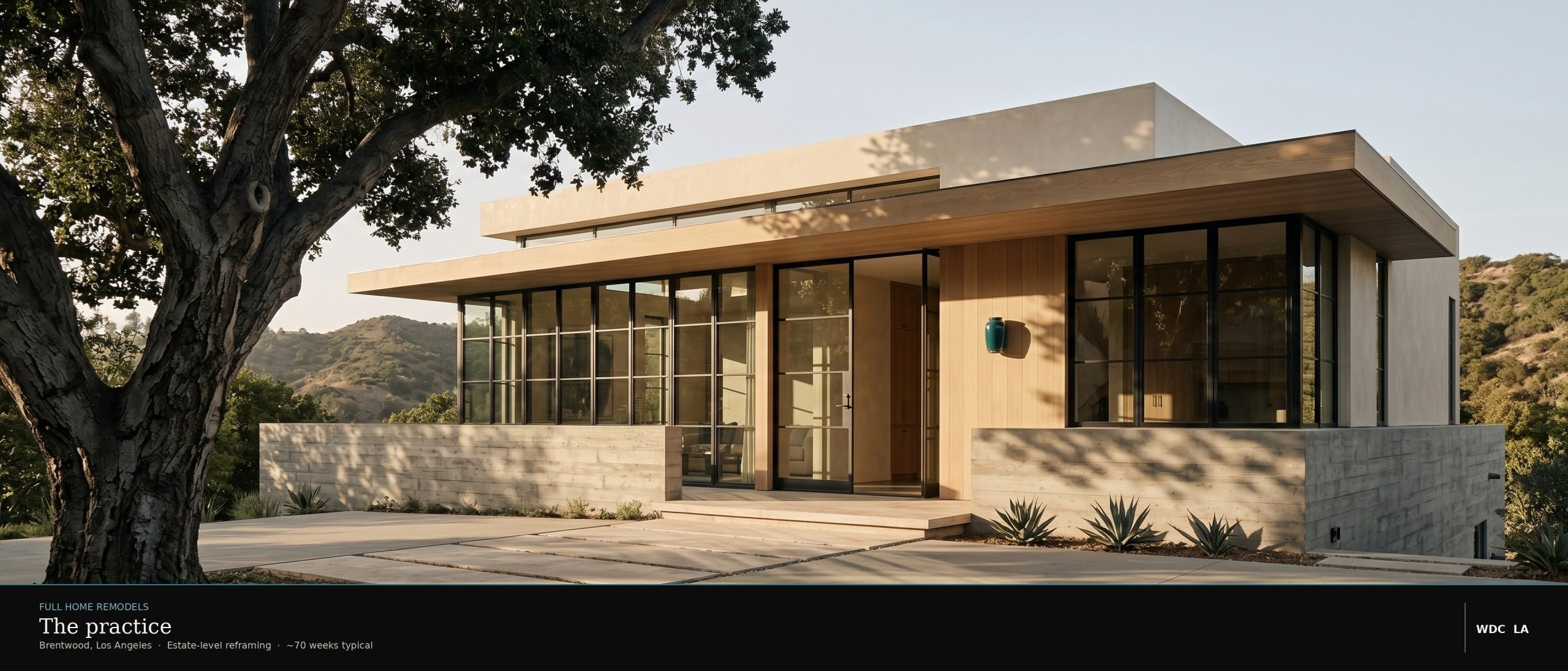
The decision between a full-home remodel and a room-by-room sequence in Los Angeles in 2026 is rarely about budget — both paths land in the $800K to $3M range on luxury homes. The decision is about disruption, equity recapture, and what the home needs to be at the end. A full-home remodel completes in 9 to 14 months at a 12–18% delivery premium over the room-by-room aggregate. A room-by-room sequence extends across 24 to 36 months, lets the family stay in place, but eats roughly 12–18% in mobilization and re-mobilization friction. We Do Construction — a Los Angeles design-build firm licensed in California (CSLB #1096552) and listed in the Architectural Digest PRO Directory — delivers both. The Brentwood Light Study, a recent 4,800-square-foot full-home reno, is a working illustration of when the full-home path is the right call.
Project
Brentwood Light Study
Neighborhood
Brentwood · 1960s mid-century base
Scope
Full-home reno · 4,800 sf · structural
Approach
Full-home · family relocated
Calendar
12 months kickoff to move-in
Delivery
Design-build · WDC
Luxury LA
Full Home
Room-by-Room
Sequenced Path
The honest headline number

On the same 4,800-square-foot home, the two paths look like this:
The often-quoted “doing it all at once is cheaper” answer is technically true. The actual delta is 12–18%, not the 30–40% sometimes claimed. The real reason to choose full-home is rarely cost.
When full-home makes sense
The full-home path is the right call when any of five conditions apply:
- Structural changes touch multiple rooms. Removing a load-bearing wall on the main floor frequently affects the kitchen, living room, and the second-story plan above. Sequencing this room-by-room is impractical.
- The systems are at end-of-life. 1950s and 1960s LA homes routinely need full re-plumb (galvanized to PEX/copper), full re-wire (knob-and-tube remnants, undersized panels), and HVAC redesign. These are one-project scopes.
- The family is comfortable relocating. Short-term rentals in luxury LA neighborhoods run $12K–$28K/month. Over a 12-month full-home build, $144K–$336K of rental cost is real money — but offset against the 12–18% friction premium on a sequenced approach.
- The home is being prepared for sale. Resale value capture is markedly stronger when the home presents as a coherent program, not a series of piecewise renovations done across five years.
- The owner values calendar certainty. A single defined start and end is simpler to manage than a multi-year sequence with floating mobilization windows.
The full-home premium is real but not what people think. The decision is rarely about money. It is about whether the family is willing to live elsewhere for a year — and whether the home needs to become a single coherent thing at the end.— Jacob Bachar, WDC
When room-by-room makes sense
The sequenced path is the right call when:
- The systems are sound. The home was built or substantially re-systemized in the 1990s or later. Mechanicals do not need touching.
- The program is genuinely modular. Kitchen, then primary suite, then guest bath — each project is bounded, does not interact structurally with the others, and can be sequenced over 24–36 months.
- The family cannot relocate. Aging-in-place considerations, school-year constraints, work-from-home setup, pet logistics, or simple preference. Stay-in-place construction is harder on the family than most people anticipate, but for some households it is the only path.
- Cash flow matters. Phasing $1.85M across three years is easier to absorb than $2.1M in twelve months for some financial profiles, even at the higher total cost.

What actually changes between the two
Five operational differences worth knowing before committing:
- Design coherence. Full-home projects produce design coherence as a byproduct — finishes, lighting, hardware, paint palette all chosen against each other. Room-by-room sequences require active discipline to maintain coherence across multi-year timelines.
- Mobilization overhead. Each room-by-room project absorbs 8–14% in mobilization and demobilization (dust containment, site protection, trade coordination, cleanup). A full-home project absorbs this once.
- Supply chain pricing. Stone, tile, fixtures, and appliances re-price each year. A full-home build locks pricing once. A 30-month sequence absorbs three pricing cycles.
- Family disruption pattern. Full-home: intense, bounded. Room-by-room: lower intensity, but extended across 2–3 years. The aggregate disruption hours often favor the full-home path.
- Resale optionality. A finished full-home project preserves resale flexibility. A partial sequence (kitchen done, primary suite next year) is harder to market mid-stream.
Timeline, end to end
Full-home path:
- Design + selections: 3–5 months
- Permitting: 3–6 months, parallel with bidding
- Construction: 9–14 months
- Total kickoff to move-in: 15 to 25 months
Room-by-room path (4 projects):
- Project 1 (kitchen): 6 months
- Gap: 3–4 months
- Project 2 (primary suite): 5 months
- Gap: 3–4 months
- Project 3 (secondary spaces): 5 months
- Gap: 3 months
- Project 4 (exterior/outdoor): 4 months
- Total: 28 to 36 months
What the numbers actually look like
Why design-build on either path
Both paths benefit from design-build delivery, but for different reasons. On the full-home path, design-build is about schedule discipline — keeping a 25-month calendar from drifting requires structural and finish decisions made once, with the field crew in the room when they are made. On the room-by-room path, design-build is about maintaining design coherence across 24–36 months — finishes selected in year one need to read with finishes selected in year three, and only a single delivery team can hold that thread.
Design-build full-home remodeling and design-build sequenced projects share the same underlying premise: one team, accountable for both design and construction, from kickoff to punch.
Frequently asked questions
Is a full-home remodel cheaper than room-by-room?
How long does a luxury full-home remodel take in LA?
What does a luxury full-home remodel cost in LA?
Can my family stay in the home during a full remodel?
When is room-by-room the right call?
Related Projects
Brentwood Light Study

The Palisades Courtyard
Beverly Hills Kitchen Volume