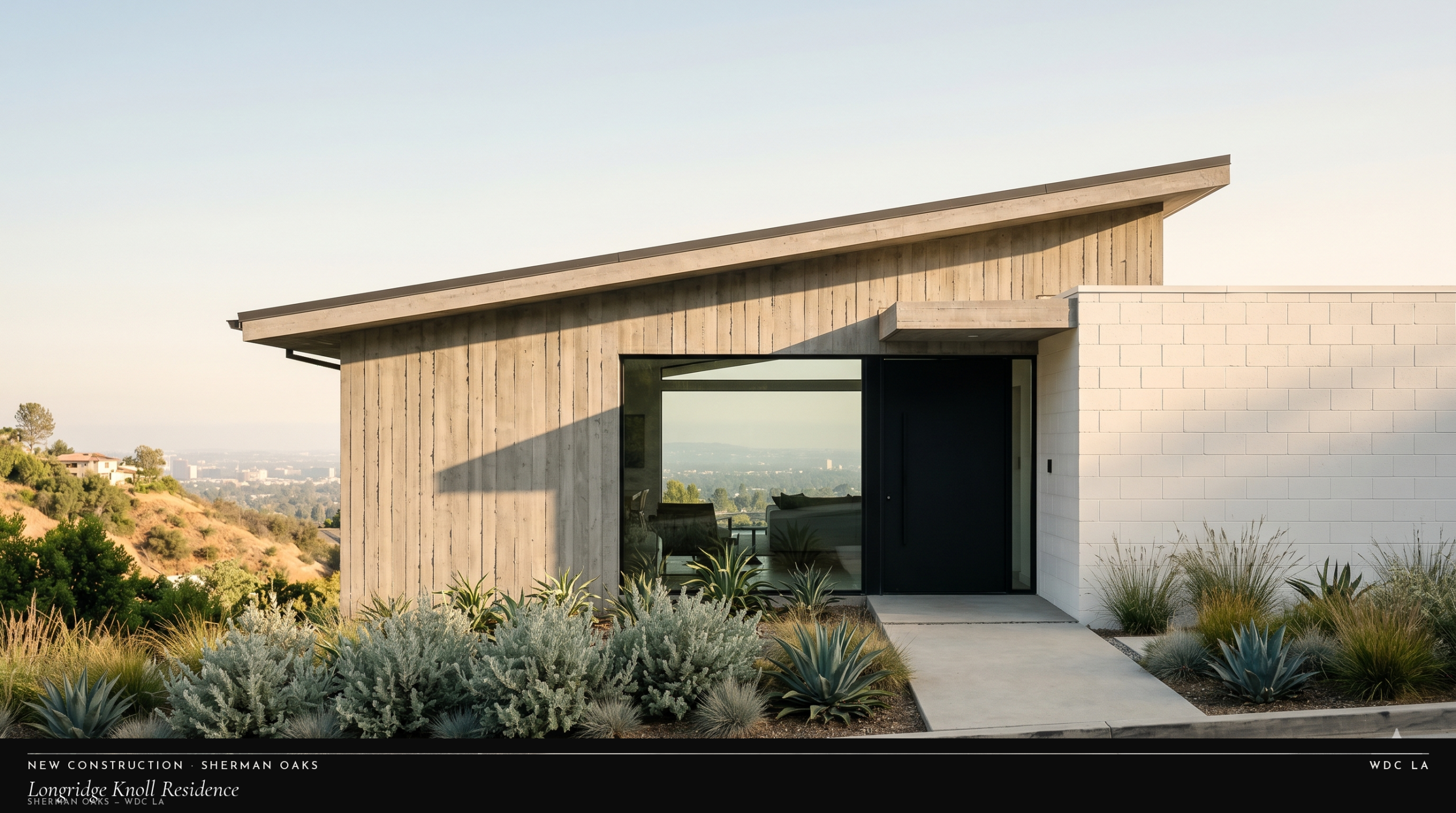
Ground-up new construction on a Sherman Oaks hillside lot typically runs 28 to 40 months from soil sample to Certificate of Occupancy, with hard costs between $800 and $1,400 per square foot at the architectural-grade tier. The Los Angeles Department of Building and Safety classifies most Sherman Oaks parcels north of Ventura Boulevard under the Baseline Hillside Ordinance, which restricts buildable floor area by average slope, caps by-right grading export at 1,000 cubic yards, and requires a stand-alone geotechnical review before any structural drawing reaches plan check. We Do Construction — a Los Angeles design-build firm licensed in California (CSLB #1096552) and listed in the Architectural Digest PRO Directory — builds on these lots. The Longridge Knoll Residence, a current WDC project on the south-facing slope above Hayvenhurst Avenue, is a working illustration of the sequencing, permitting, and structural decisions a Sherman Oaks hillside build actually requires.
Project
Longridge Knoll Residence
Neighborhood
Sherman Oaks · south-facing slope above Hayvenhurst
Status
In construction · 2026
Lot
Hillside · BHO-regulated · bedrock at 22′
Foundation
Caisson + grade beam · 8 caissons
Delivery
Design-build · WDC
Lot to C of O
per Sq Ft
BHO Export Cap
Cost Delta
The site decides the building, not the other way around

On a hillside, the soils engineer is the first consultant on the project, not the architect. A typical Sherman Oaks hillside parcel begins with four documents that must exist before design is anything but speculation:
- Geotechnical investigation — $8,000 to $15,000, four to six weeks.
- Topographic and boundary survey — $3,000 to $6,000.
- Slope analysis under the Baseline Hillside Ordinance.
- Stormwater plan filed under the LA County MS4 permit.
The Longridge Knoll lot returned bedrock at 22 feet — a useful number, because it ruled out a deep mat foundation and confirmed caisson-and-grade-beam was the right structural call. That decision was made in week three, before schematic design closed.
On a hillside, the soils engineer is the first consultant on the project — not the architect. Skip that order, and you spend year two of construction unwinding decisions made in year one.— Jacob Bachar, WDC
Permitting under the Baseline Hillside Ordinance
The BHO is the central document. Most Sherman Oaks lots north of Ventura fall inside it. Four constraints drive every early design decision:
- Buildable floor area scales down as average slope increases. A 7,500 sf lot at 30% slope yields meaningfully less by-right area than the same lot at 15%.
- Grading export is capped at 1,000 cubic yards by right. Anything beyond that triggers a haul-route review and a public hearing track that adds three to six months.
- Setbacks widen on slopes above 15%. Side-yard requirements scale.
- Plan check runs three to five rounds on hillside parcels — versus one or two on a flat-lot remodel.
Total entitlement-to-permit timeline on a hillside ground-up: 12 to 18 months.
Foundation systems for slope
What gets specified depends on the geotech report. Three systems cover almost every Sherman Oaks hillside ground-up build:
Architectural vernacular for a Sherman Oaks hillside

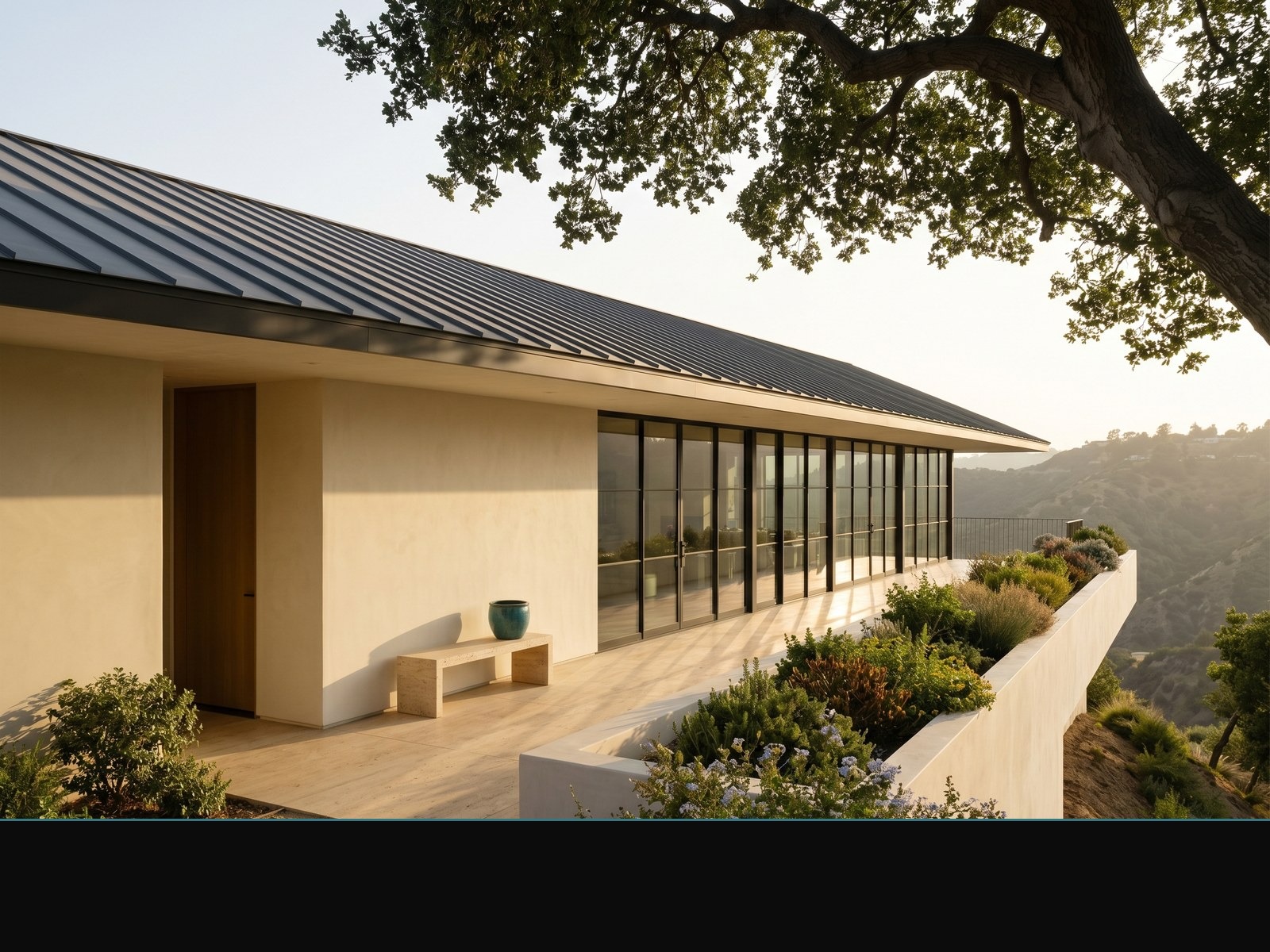
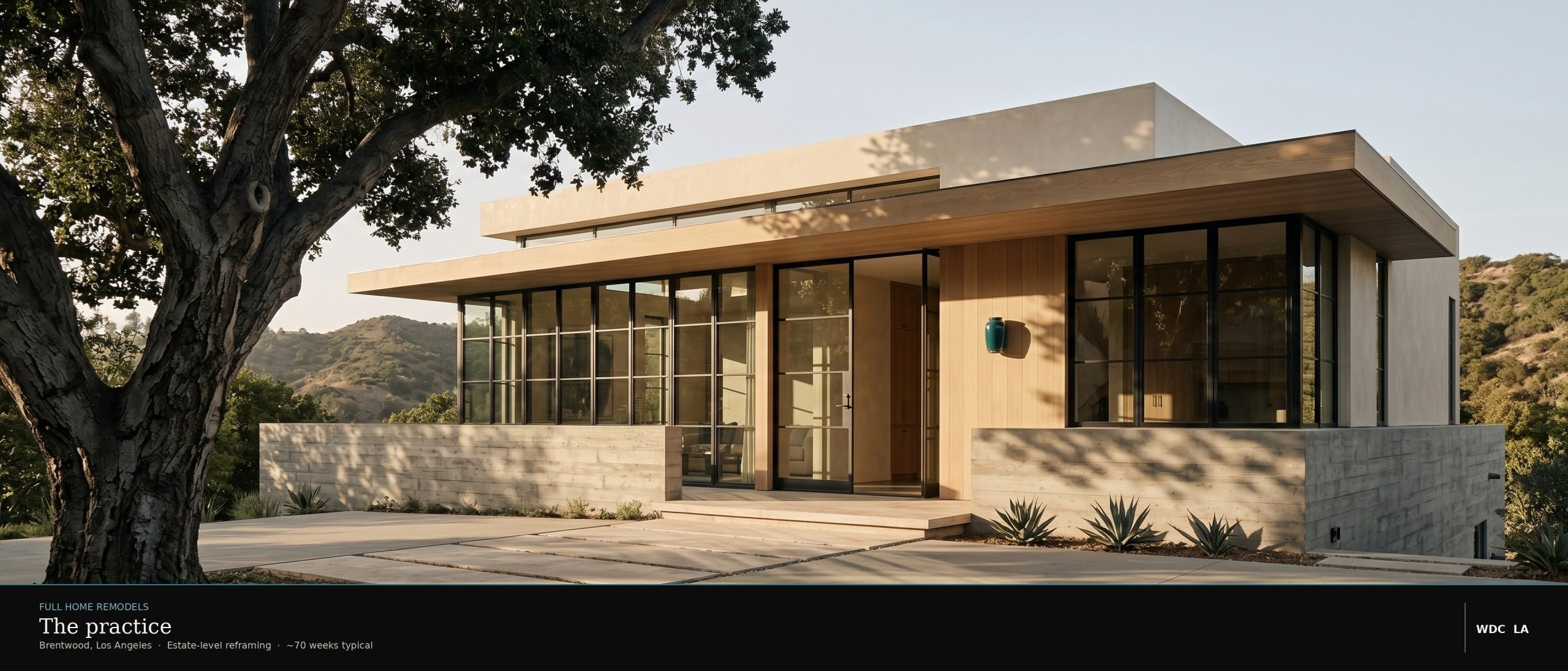
Sherman Oaks hillside lots at the design-led tier reward modernism specifically — long, low horizontal massing that follows the slope rather than fighting it. Five patterns hold up across the south-facing knolls above Ventura Boulevard and the hill-tops west of Sepulveda. We Do Construction specifies these as a baseline on Sherman Oaks ground-up builds: view-facing glass with thermal-broken steel framing oriented south or southwest toward the basin; cantilevered overhangs sized for summer shading without losing winter solar gain; standing-seam zinc, board-formed concrete, fiber cement, or stained cedar — used in combinations of two materials, rarely three; indoor-outdoor flow staged across a single grade plane, with a secondary terrace at the lower contour; and a parking and arrival sequence that brings the auto-court above the residence rather than below, so the public spaces orient outward to the view, not back uphill toward the street.
Restraint, not minimalism. Two primary materials, rarely three. Color saturation belongs to the landscape, not the building.— On Sherman Oaks hillside vernacular
Timeline, end to end
- Pre-design (geotech, survey, programming): 3–5 months
- Schematic Design and Design Development: 4–6 months
- Construction Documents: 4–5 months
- Plan check and permit: 6–9 months, in parallel with bidding
- Construction: 16–22 months
- Total: 28 to 40 months
What the numbers actually look like
Why design-build matters more on a hillside than a flat lot
Two failure modes show up on architect-led, contractor-bid hillside projects. First, the architect designs without builder input on what is actually constructible on the slope, leading to value engineering after the drawings are already in plan check — which usually means redrawing, which usually means re-permitting. Second, the general contractor inherits a drawing set written for a flatter site and absorbs the variance as change orders during construction.
Design-build new construction collapses both gaps. Foundation, retaining, grading export, and finish-material decisions are made once, with the structural and architectural teams in the same room — not handed off across two contracts.
Frequently asked questions
How long does ground-up new construction take on a Sherman Oaks hillside?
What does hillside new construction cost per square foot?
What is the Baseline Hillside Ordinance?
What foundation system works best on a Sherman Oaks hillside?
Why does design-build matter on a hillside?
Related Projects
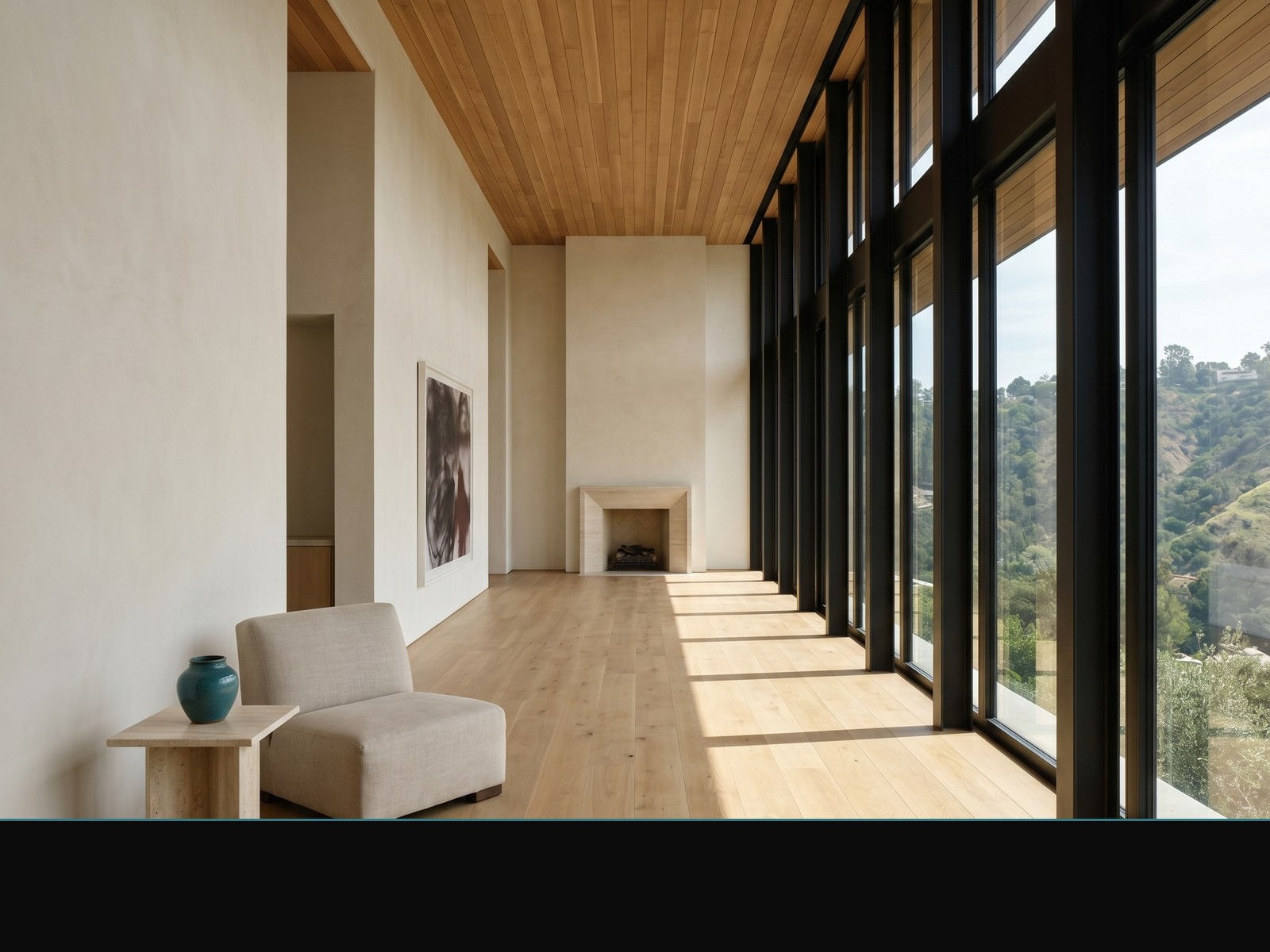
Bel Air Frame
Mandeville Spine
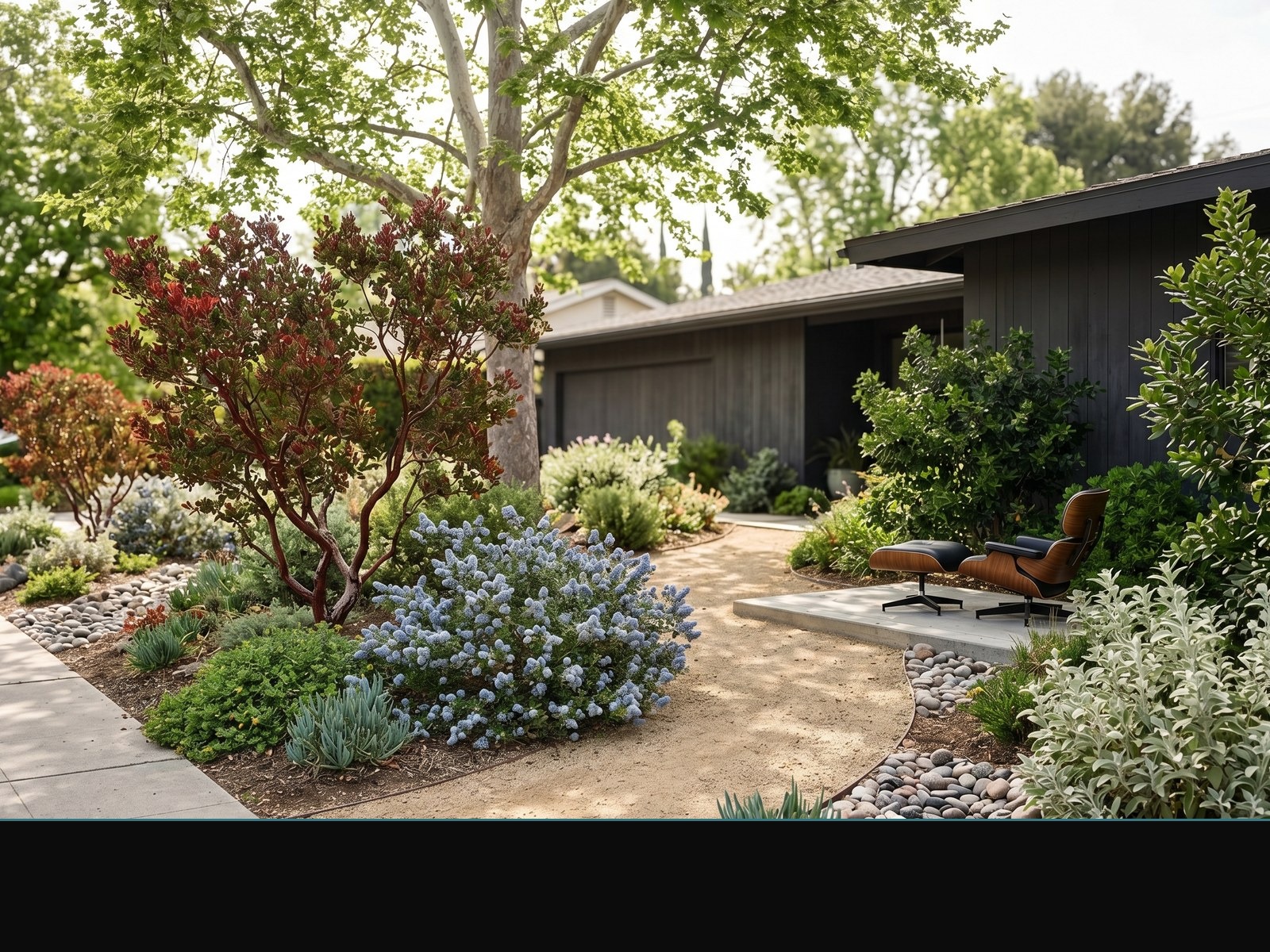
Sherman Oaks Drought Garden